Dental problems and Hand Feeding.
This page talks about teeth problems and emergency feeding of sick chinchillas that are either unwilling or unable to feed themselves. It is also relevant to degus and guinea pigs. If you are looking for information about feeding healthy chinchillas the try the feeding chinchillas and degus or feeding guinea pigs page.
Important: If you are worried about your chinchilla please take your pet to the vet as soon as possible. Not eating is always a symptom of a serious problem and your chinchilla may die very quickly. Only hand feed your chinchilla after discussing it with your vet - in some conditions it can actually cause more harm. This page is only designed to share my experiences not as vetinary advice.
Why isn't my pet eating?
The first thing that needs to be done is to identify why your pet is not eating and treat the problem, and that means a visit to the vets as soon as possible.
Dental problems are a common cause of lack of appetite but an infection, kidney or liver problems, gut problems pain due to injury or illness can be the problem. In an animal with a gut problem forcing them to eat can actually make matters a lot worse so I would not advise any kind of hand feeding until you have seen the vet.
Teeth problems are sadly a common problem in particularly in chinchillas and degus. Symptoms are loosing weight, obvious problems eating, pawing at the mouth, dropping food when eating, drooling and even weepy eyes and constipation. However many animals will initially only loose weight initially as they are eating less. By the time weight loss becomes really visible your pet will already have lost quite a bit of weight. Because of this I always weigh by pets every couple of weeks - weight loss of more than about 10% (say 30g for a degu, 60g for a chinchilla or 100g for a guinea pig) may be a sign of a problem.
It is very difficult to diagnose teeth problems in a conscious chinchilla and they often have to be anaesthetized to be checked and some problems need an x-ray to diagnose. Not all vets have a lot of experience with chinchillas and you may need to ask and phone around to find a vet who has more experience. If you want to read more about chinchilla dental problems the Dacross vetinary dentistry website has a wealth of information.

Should I be hand feeding at all?
If you spend any time on forums for chinchillas, guinea pigs or degus you will come across people syringe feeding their pets, and if you put a post up about a sick animal that is not eating someone will invariably tell you that you must start syringe feeding immediately. But you have to think carefully (and take vetinary advice) before starting to do this. The important questions are "why is my pet not eating?", "how long are they likely to be not eating for?" and 'are they going to improve?".
Syringe feeding can provide vital nutrition and help to maintain gut function whilst your pet recovers from an illness or heals from dental surgery. So an example of when it may be appropriate is for a short while after major dental surgery in a chinchilla when they have a very sore mouth. However there is also a high risk of aspiration - food getting into the lungs and causing the animal to choke or get pneumonia. It is also very stressful for your pet and longer term force feeding too much food can cause metabolic problems and compound dental problems because the animal does not need to chew food.
You hear tales of people syringe feeding for months after surgery - this is not about the animal not being able to eat but often more about the owner feeling a desperate need to be doing something. If a small animal will eat anything for themselves do not syringe feed unless specifically instructed to do so by your vet. If they cannot feed themselves long term then some difficult decisions need to be made.
Stopping eating is also a natural part of the end of life of sick animals. Sadly there are many illnesses such as cancer and liver and kidney problems for which a vet can do very little. Sadly letting them go painlessly is often the last kind thing that we get to do for our pets.If your pet is obviously terminally ill and suffering then you have to ask what the benefit is to prolonging the pain? So for example syringe feeding an elderly guinea pig that has stopped eating for no identifiable cause is simply cruel. It is also cruel to keep a chinchilla that cannot eat due to dental pain that is not improving alive by syringe feeding them. It is sometimes more difficult when you have got into the cycle of more and more heroic efforts to save your beloved pet, just because something is possible and you have a vet willing to do it, it doesn't necessarily make it right. Ask your vet for an honest assessment of likely success. In my experience most Vets are very reluctant to put an animal to sleep if there is any chance of saving them and so if your vet recommends this action then it is probably the best thing to do.
After Treatment
Small herbivores digestive system is designed to manage a continual supply of low quality forage and it is often said that if these animals do not eat continually the normal movement of the gut will stop and be difficult to start again. However this is not going to happen overnight if your pet was eating before surgery, and it is common for an animal to not be that keen on eating when they first come round from an anaesthetic when they really need to be resting not being manhandled. So provide them with something nice to eat and give them a chance to recover overnight. For example guinea pigs will nearly always eat fresh grass and chinchillas and degus will often eat softened pellets in mashed banana if they have a sore mouth or something like porridge oats otherwise.
For chinchillas with dental work it is common for vets to try to improve the problem by burring the molars to try to remove any sharp spurs or to flatten the bite so that teeth wear correctly. It is common for chinchillas to have a very sore mouth after this both as a result of the teeth being burred and also damage to the gums and mouth lining can develop into mouth ulcers.Sadly, by the time that some chinchillas receive treatment they are no longer eating and often are very thin indeed.
It is very important to have adequate pain relief, the vet will probably inject a long acting pain killer after the operation. But you may need something more after this. Ask your vet about this before the operation - they may give you something like Metacalm which is mild pain relief on the level of something like asprin/paracetamol. They can also give injections of something like Vetergesic (Buprenorphine). This is a much stronger opiod painkiller which is more suitable for severe pain. We also successfully treated Spike with it orally (0.1ml every 12 hours) for an infected ulcer after surgery - this is really worth discussing with your vet if your chinchilla is obviously having pain problems after surgery. However it is worth bearing in mind that some pain relief can suppress appetite.
Chinchillas with other conditions like pneumonia can need hand feeding as well if they have stopped eating. Syringe feeding is often recommended for chinchillas that have stopped eating, but it can be difficult to do safely and quite stressful for owner and chinchilla. Sometimes it is necessary and there are good details of how to do it on the Azure Chinchillas website (although we do disagree on how soon it should be done - again best advice is to talk to your vet). Try to find someone that can demonstrate it to you if your chinchilla will not eat any other way. There are owners with experience of this on the Chinchillas Unlimited forums.
However, there is an alternative. Most chinchillas can be fed softened food from a spoon whilst sat on your lap. The trick is to be as quiet and calm as possible so as not to turn it into a fight between you and your chinchilla. Put an old towel over your lap and sit the chinchillas quietly. You need to be patient. To start off with you may need to spend half an hour three or four times a day getting a small amount down your chinchilla. But this often will keep a chinchilla going until their mouth heals.
Take a piled spoonful of the softened food (see below for making a feed) and put it by their mouth. Some chinchillas will eat of their own accord or sometimes you need to gently touch the food to their mouth. They will then take a bite - often out of irritation - and once the food is in their mouth they will chew and swallow it, rather than spitting it out. If you are lucky you may find that your chinchilla will take food off the spoon in their cage, or even eat softened food from a bowl. But some chinchillas, like Fluff here, will need to be spoon fed.
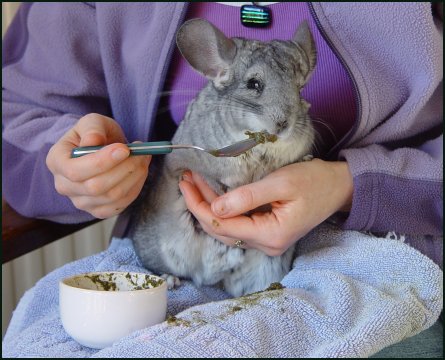
The aim is to start hand feeding your chinchilla and get them back onto normal food as soon as they can manage it, making the feed less liquid and leaving longer between feeds.
With her recent dental surgery Fluff would eat nothing at all when it was first done - she had an infected ulcer in her mouth. She looked very sorry for herself indeed, but I could get her to take very soft food from a spoon - a small amount 4 times a day. She went back to the vet after 5 days because she still wasn't producing any droppings and the vet gave her an injection that can help get the gut moving. After a week she started to take raisins and I stopped feeding her to encourage her to feed herself, but she lost weight rapidly and I started again. However part of the weight loss was due to her starting to produce droppings again. I cut down to two feeds a day and at two weeks she was starting to eat her pellets. I cut it to feed a day for another week and stopped all together by 3 weeks, by which time she was showing signs of chewing some toys a bit. I got 25g on her whilst spoon feeding, but she dropped 20g again when I stopped. However after a few nerve wracking days when her weight stabilized she started to gain again. One of the problems can be that the chinchilla associates eating with pain and if you are stopping them from being hungry by feeding them softened food they haven't got the motivation to start eating again. However, long term feeding of soft food will stop the molars wearing down properly and can make teeth problems worse so it is vital to spoon feed for as little time as possible. With hindsight I should probably have been a little braver and stopped sooner. Because it was caught quickly Fluff was nearly 600g in weight even after the operation. Some chinchillas can be under 400g, and in this case getting weight on them can sometimes be the more important.
Making a Feed.
Specialist emergency feeds that you mix with water and contain additional fibre, nutrients and probiotics are available, such as Supreme Science Recovery and Oxbow Critical care. These are excellent, but quite expensive and not always easy to get hold of in a hurry. The simplest form of feed is to soak pellets in warm water (preferably pre-boiled and cooled from a kettle to kill any bacteria) until they go soft. But if you have a coffee grinder (or buy one, they aren't very expensive) you can do a better job. Grind the pellets up into a fine powder and place in a bowl. Then grind up some alfalfa and/or hay - you may need to chop it with scissors before putting it into the grinder. If you sive it after grinding you get finer pieces. Adding about a third of this to the mixture gives the fibre that is necessary to keep the chinchillas insides healthy. Oxbow Western Timothy Hay and Alfalfa Nibbles are good for this. One of the advantages of making this sort of feed up is that you are feeding the chinchilla exactly what they would get in their normal diet. I mix this up to a sloppy paste with tepid/warm water (again preferably pre-boiled - make sure it isn't too hot).
It's probably worth considering adding a pro-biotic to the mix, especially if your chinchilla is getting antibiotics which can kill the good gut bacteria as well as infections. Your vet should have probiotics for small herbivores or you can buy a product such as Vetark Avipro or they are becoming more common in large pet shops. Because chinchilla pellets are already supplemented with vitamins and minerals there is no benefit of adding more and high levels of some can be toxic.
It is absolutely essential to get your pet back onto a normal diet as soon as possible for normal teeth wear - see the feeding chinchillas and degus or feeding guinea pigs page.